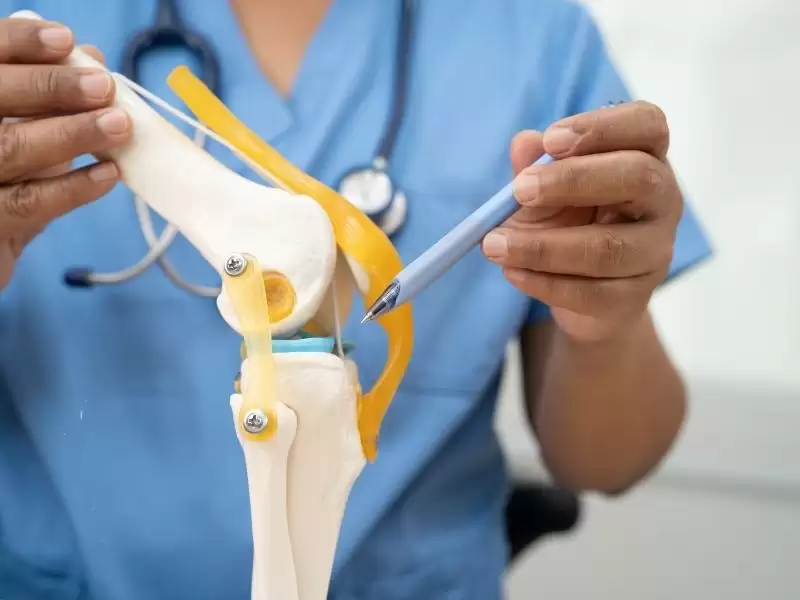

The knee joint is one of the most important weight-bearing joints in the body. Walking, going up and down stairs, sitting down and standing up, squatting, and many daily movements are possible with a healthy knee joint. However, over time, wear on the joint surfaces, cartilage loss, and deformity may develop. Especially in advanced stages, this condition may lead to pain, limited movement, and a significant decrease in quality of life.
When knee osteoarthritis progresses and non-surgical treatments do not provide sufficient relief, prosthetic surgery may come to the agenda. At this point, one of the topics patients most frequently wonder about is the difference between total knee replacement and partial knee replacement. Both methods aim to treat the damaged part of the knee joint; however, they differ from each other in terms of how they are performed, suitable patient groups, preserved tissues, and recovery process.
The correct prosthesis selection should not be made by looking only at an X-ray result; the patient’s pain level, the extent of knee osteoarthritis, the condition of the ligament structures, range of motion, age, daily life expectations, and orthopedic examination findings should be evaluated together.
Total knee replacement is a surgical treatment method used in patients with advanced osteoarthritis or widespread joint surface damage in more than one part of the knee joint. In this procedure, the damaged surfaces forming the knee joint are replaced with special prosthetic implants.
The knee joint basically consists of the thigh bone, shin bone, and the structures around the kneecap. As cartilage tissue wears down over time, the natural smoothness between the bones decreases. This may cause pain, friction, restricted movement, and deformity in the leg shape. The aim of total knee replacement is to restore the damaged joint surfaces, reduce the patient’s pain, and help them walk more comfortably and perform daily activities more easily.

This method is usually preferred when both the inner and outer parts of the knee or the kneecap joint are widely affected. Total replacement may be considered especially in complaints such as advanced osteoarthritis, significant leg deformity, severe loss of movement, and night pain.
Partial knee replacement is a partial prosthesis method performed when only one part of the knee joint is damaged. The knee joint consists of different regions such as the inner compartment, outer compartment, and kneecap joint. In some patients, osteoarthritis may remain limited only to the inner or outer part of the knee. In this case, instead of replacing the entire knee joint, it may be possible to apply a prosthesis only to the damaged area.
In partial knee replacement, healthy joint surfaces, bone tissue, and ligament structures are preserved as much as possible. Therefore, in suitable patients, it may provide advantages such as a more natural knee feeling, a smaller surgical area, and faster recovery. However, this method is not suitable for every patient with knee osteoarthritis. The osteoarthritis must be limited, the ligaments must be intact, and the knee range of motion must be at an adequate level.
Partial knee replacement may also be medically referred to as partial knee prosthesis or unicondylar knee replacement. When patient selection is made correctly, it may be an effective treatment option.
The main difference between total and partial knee replacement is how much of the knee joint is replaced. In total knee replacement, a wider part of the knee is addressed, while in partial knee replacement only the damaged compartment is treated.
In partial knee replacement, preserving healthy tissues is prioritized. Therefore, in suitable patients, the natural movement sensation of the knee may be better preserved. Total replacement, on the other hand, provides a more comprehensive solution for patients with widespread osteoarthritis.
The table below compares the two methods in general terms:
| Comparison Criteria | Total Knee Replacement | Partial Knee Replacement |
|---|---|---|
| Application Area | It is performed when there is widespread osteoarthritis or damage in more than one part of the knee joint. | It is performed when osteoarthritis is limited only to the inner or outer part of the knee. |
| Preserved Tissues | A wider joint surface is replaced; the surgical area is more comprehensive. | Healthy joint surfaces, bone tissue, and ligament structures are preserved to a greater extent. |
| Patient Suitability | It may be preferred in patients with widespread knee osteoarthritis, advanced deformity, severe movement limitation, and ligament imbalance. | It may be considered in patients with single-compartment osteoarthritis, intact ligament structure, and suitable knee range of motion. |
| Knee Feeling | It is a comprehensive surgical option aimed at reducing pain and improving knee function. | Since healthy tissues are preserved, it may provide a more natural knee feeling in suitable patients. |
| Recovery Process | Due to more comprehensive surgery, the physical therapy and recovery process may be longer depending on the individual. | In suitable patients, recovery may be faster because the surgical area is more limited. |
| Revision Possibility | The lifespan of the prosthesis depends on the patient’s age, weight, activity level, bone structure, and prosthesis positioning. | If osteoarthritis progresses in other parts of the knee, conversion to total knee replacement may be needed in the future. |
| Advantage | It offers a more comprehensive and holistic treatment option in widespread joint damage. | It may provide a more limited surgery, greater tissue preservation, and a more natural movement sensation in suitable patients. |
| Limitation | It requires a wider surgical procedure compared to partial replacement. | It is not suitable for every patient; with incorrect patient selection, persistent pain or revision need may occur. |
Total knee replacement may be preferred when cartilage loss and joint surface deterioration occur not only in one part of the knee joint but in more widespread areas. Total replacement may be more suitable especially in patients where both the inner and outer parts of the knee are affected, kneecap joint problems accompany the condition, or there is significant leg alignment deformity.
When knee osteoarthritis progresses, patients may notice that their walking distance decreases, they have difficulty going up and down stairs, and pain increases during daily activities. In some patients, resting pain or night pain may also develop. This may indicate that joint wear has reached an advanced level.
Total knee replacement may be considered in the following situations:
This decision should be made individually. Not every patient with knee pain at an advanced age may require a prosthesis.
Partial knee replacement may be preferred in patients whose knee joint damage is limited. This method may come to the agenda especially if osteoarthritis is located only in the inner part of the knee or, more rarely, in the outer part, and the other areas of the knee are healthy.
Unicondylar knee replacement may provide successful results in patients with intact ligament structures and sufficient knee range of motion. The aim of this method is to treat only the damaged area and preserve the natural structure of the knee as much as possible.
For partial knee replacement to be considered, the following conditions are generally sought:
Osteoarthritis being limited to a single compartment
The anterior cruciate ligament and other ligament structures being sufficiently intact
The knee range of motion being suitable
No advanced deformity being present
No significant cartilage damage in other parts of the knee
The patient’s expectations and lifestyle being suitable for this method
Partial knee replacement can be performed with a smaller surgical area; however, incorrect patient selection may lead to persistent pain or the need for conversion to total replacement in the future.
Total knee replacement is more suitable for patients with widespread joint damage. If there is osteoarthritis in different parts of the knee, a partial prosthesis applied to only one area may not be sufficient. In this case, total replacement offers a more comprehensive treatment option.
Total knee replacement may be considered in patients who have difficulty going up and down stairs, whose walking distance has significantly decreased, who cannot stand for a long time, and who do not receive sufficient benefit from methods such as medication, injections, or physical therapy.
When choosing among knee replacement types, not only the patient’s age but also the extent of joint damage and functional status are important. Some older patients may be suitable for partial replacement, while a younger patient may require total replacement due to widespread osteoarthritis.

Partial knee replacement is suitable for patients with more limited joint damage. If osteoarthritis is present in only one part of the knee and the other parts are healthy, treating the damaged part instead of replacing the entire knee joint may be a more protective approach.
This method may provide an advantage for patients who want a more natural knee feeling in daily life and whose ligament structures are preserved. Preserving healthy tissues may create a more comfortable movement sensation in some patients. However, the most important point here is to evaluate in detail whether the patient is truly suitable for partial replacement.
Partial knee replacement may be an important option for patients who have one-sided knee pain, limited damage on X-rays, and suitable ligament balance on examination.
Knee replacement surgery is based on replacing the damaged surfaces of the knee joint with prosthetic implants. However, the surgical area and scope of application differ in total and partial replacement surgeries.
During total knee replacement surgery, wider surfaces of the knee joint are prepared. The damaged cartilage and bone surfaces are reshaped, and then the prosthetic components are placed in the proper position. In this procedure, the overall balance of the knee, leg alignment, and compatibility of ligament structures are carefully evaluated.
Partial knee replacement surgery, on the other hand, focuses only on the damaged compartment. Healthy joint surfaces are preserved. Therefore, the surgical area is more limited. However, for partial replacement to be successful, accurate positioning of the prosthesis, preservation of ligament balance, and proper patient selection are of great importance.
In both methods, preoperative X-ray evaluation is of fundamental importance. In necessary patients, the extent of osteoarthritis may be examined in more detail with advanced imaging methods.
Recovery after knee replacement varies depending on the type of prosthesis used, the patient’s general health condition, muscle strength, age, and preoperative activity level. Rehabilitation after total knee replacement is generally more comprehensive. In partial knee replacement, faster recovery may be observed in suitable patients.
In the postoperative period, early walking, pain control, preservation of knee range of motion, and physical therapy are important. Patients are usually helped to stand up in a controlled manner and walking exercises are started. The aim in this process is to ensure safe knee movement and support muscle strength again.
Since the surgical area is more limited in patients who undergo partial knee replacement, some patients may return to daily life earlier. However, this is not the same for everyone. Successful functional recovery can also be achieved after total knee replacement with proper rehabilitation.
There is no single answer to this question. The most advantageous method is the one that best suits the patient’s knee structure and the extent of osteoarthritis. Partial knee replacement may be advantageous in suitable patients due to preserving healthy tissues, providing a more natural knee feeling, and offering faster recovery potential.
Total knee replacement, on the other hand, may be the more appropriate option in patients with widespread osteoarthritis. Treating only one area does not eliminate the existing damage in other parts of the knee. Therefore, total replacement provides a more comprehensive solution in patients with extensive joint damage.
The important question here is not “which prosthesis is better?” but “which prosthesis is more suitable for this patient?”

The decision for knee replacement is not made solely based on the presence of osteoarthritis on X-rays. In some patients, imaging may show advanced deterioration, but symptoms may be milder. In other patients, pain and limited movement may seriously affect daily life.
The following points are evaluated during the decision-making process:
Severity and duration of pain
Walking distance
Ability to go up and down stairs
Whether night pain is present
Knee range of motion
Leg alignment and deformity
Condition of ligament structures
Whether osteoarthritis is limited to one area or widespread
The patient’s age and general health condition
Daily life expectations
As a result of these evaluations, it is determined whether total knee replacement or partial knee replacement is the more suitable option.
For patients who want to have an Izmir knee replacement evaluation, the first step is a detailed orthopedic examination. During the examination, the location of knee pain, its relationship with movement, walking capacity, leg alignment, ligament balance, and knee range of motion are assessed. Then, imaging methods are used to evaluate in which areas osteoarthritis is present.
The aim of knee replacement planning is not only to recommend a prosthesis to the patient, but also to create a personalized surgical plan at the right time and with the right method. While non-surgical treatments may still be useful in some patients, prosthetic surgery may become the more appropriate option in others.
When choosing between total knee replacement and partial knee replacement, the patient’s lifestyle, expectations, and the current condition of the knee joint should be evaluated together. Therefore, the same prosthesis approach is not applied to every patient; the prosthesis type is determined after an individual evaluation.
Can partial knee replacement be performed on everyone?
No. Partial knee replacement is suitable only for patients whose osteoarthritis is limited to a single part of the knee and whose ligament structures are intact. In patients with widespread osteoarthritis, total knee replacement may be the more appropriate option.
Can the knee bend completely after total knee replacement?
Knee range of motion depends on the patient’s preoperative condition, muscle structure, prosthesis positioning, and physical therapy process. The aim is to provide sufficient and comfortable range of motion for daily life.
Can partial knee replacement be converted to total knee replacement in the future?
Yes. If necessary, partial knee replacement can be converted to total knee replacement in the following years. This is usually considered if osteoarthritis progresses in other parts of the knee or if a problem related to the prosthesis develops.
At what age is knee replacement surgery performed?
Age alone is not the determining factor for knee replacement. The patient’s pain, the degree of osteoarthritis, movement limitation, general health condition, and quality of daily life are evaluated together.
When can a patient walk after knee replacement?
In most patients, controlled walking is started in the early postoperative period. The timing of walking may vary depending on the patient’s general condition, the surgical method used, and the physician’s rehabilitation plan.
Is partial knee replacement less painful?
Since the surgical area is more limited in partial knee replacement, faster recovery and less early postoperative discomfort may be seen in suitable patients. However, pain levels vary from person to person.
How many years does total knee replacement last?
The durability of total knee replacement depends on the patient’s weight, activity level, bone structure, prosthesis positioning, and usage habits. Regular follow-up is important for evaluating the lifespan of the prosthesis.
Can patients climb stairs after knee replacement surgery?
Yes. As recovery and physical therapy progress, stair climbing and descending exercises may be performed. However, this process should progress in a controlled way and be increased as the patient’s muscle strength becomes sufficient.